
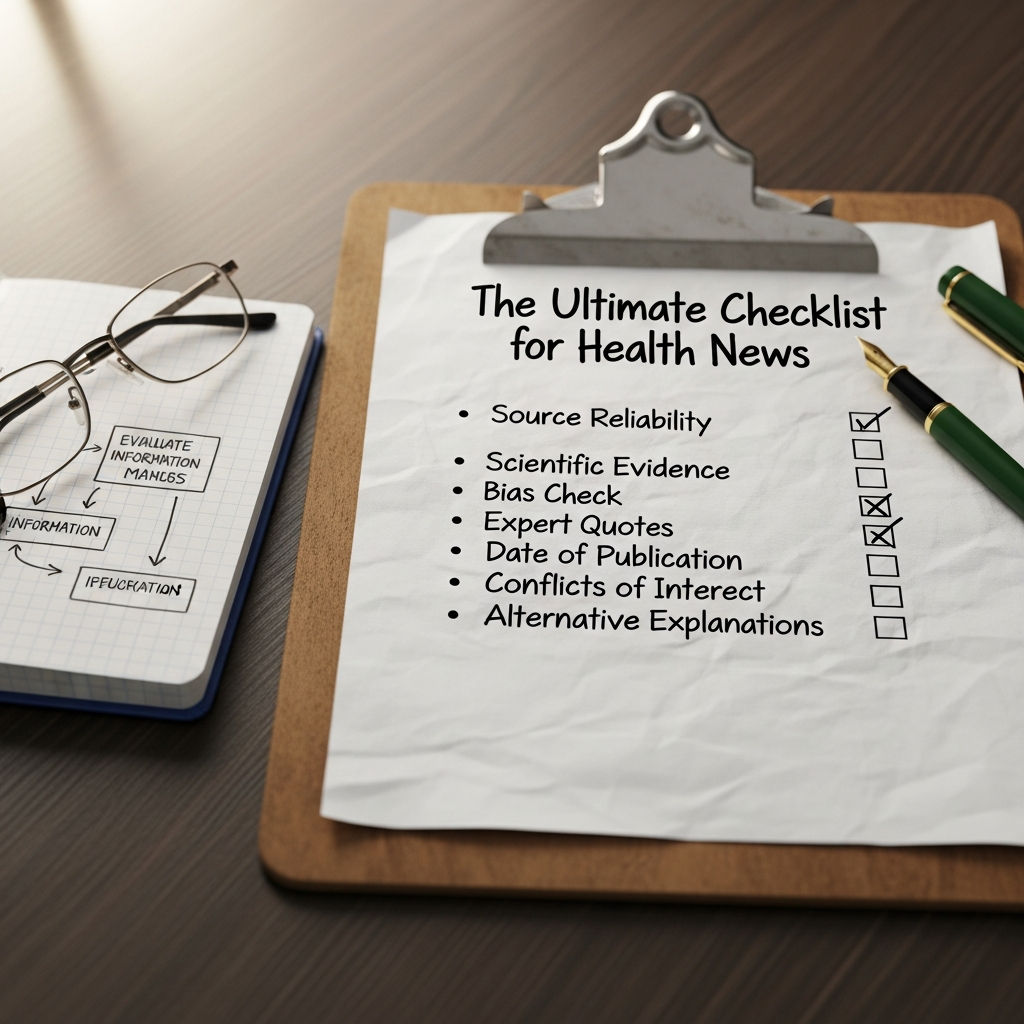
The Ultimate Checklist for Health News: How to Navigate the Sea of Information
In an era where information travels at the speed of light, health news is everywhere. From social media feeds claiming a “new miracle cure” for weight loss to mainstream headlines warning of the dangers of a common household ingredient, the volume of health-related content is staggering. However, not all health news is created equal. In fact, a significant portion of medical reporting is oversimplified, sensationalized, or based on preliminary data that hasn’t been properly vetted.
Developing health literacy is no longer just a skill for doctors and researchers; it is a vital survival tool for the general public. Misinterpreting a health headline can lead to unnecessary anxiety, the adoption of dangerous diets, or the discontinuation of essential medications. This ultimate checklist for health news is designed to help you separate scientific fact from viral fiction, ensuring you make informed decisions about your well-being.
1. Who is Reporting the News?
The first step in evaluating any health story is to look at the source. Not all platforms have the same standards for accuracy and evidence. When you encounter a health story, ask yourself:
- Is it a reputable news organization? Established outlets like the New York Times, BBC, or Reuters often have dedicated science and health reporters who understand how to interpret data.
- Is it a peer-reviewed journal? The gold standard for health news is a study published in a journal like The Lancet, JAMA, or The New England Journal of Medicine. If the “news” comes from a personal blog or a company selling a supplement, be extremely skeptical.
- Does the article link to the original study? Credible health reporting should always provide a direct link to the primary research. If an article makes a claim without citing a source, it’s a major red flag.
2. Human Trials vs. Animal or Cell Studies
One of the most common ways health news misleads the public is by reporting on animal or laboratory studies as if the results apply directly to humans. While mice and rats share some biological similarities with humans, the vast majority of “breakthroughs” seen in animal models never translate to human success.
- Check the subjects: Did the study involve humans? If the study was performed on mice, fruit flies, or cells in a petri dish, the results are preliminary and should not change your health behavior yet.
- The “In Mice” Rule: There is a popular Twitter account dedicated to adding “IN MICE” to sensationalized headlines. Always check if the “cure” found in the headline actually worked in a living, breathing person.
3. Correlation vs. Causation
This is perhaps the most frequent error in health journalism. Correlation means two things happened at the same time; causation means one thing caused the other. For example, a study might find that people who eat more blueberries have lower rates of heart disease. This is a correlation.
However, it doesn’t necessarily mean the blueberries caused the heart health. It could be that blueberry eaters are generally more health-conscious, exercise more, or have higher incomes, all of which contribute to heart health. To establish causation, researchers usually need to conduct a Randomized Controlled Trial (RCT).
4. Evaluate the Sample Size (The “N” Factor)
In scientific research, size matters. The number of participants in a study is referred to as the “N.” A study with an N of 10 is much less reliable than a study with an N of 10,000. Small sample sizes are prone to “flukes” or statistical outliers that don’t represent the general population. When reading health news, look for the following:
- Was the group large enough? For a drug or diet to be considered effective for the general public, it needs to have been tested on a large, diverse group of people.
- Was the group diverse? A study conducted only on 20-year-old men may not apply to 60-year-old women. Look for studies that include various ethnicities, ages, and genders.
5. Look for Peer Review
Peer review is a quality-control process where independent experts in the same field evaluate a study before it is published. They check for methodology errors, logical fallacies, and biased interpretations. During the COVID-19 pandemic, “preprints” (studies released before peer review) became common. While preprints can speed up information sharing, they have not been vetted and should be taken with a grain of salt.
6. Understand Relative vs. Absolute Risk
Headlines love to use “relative risk” because it sounds more dramatic. For example, a headline might scream: “Eating Processed Meat Increases Your Risk of Cancer by 18%!” This sounds terrifying. However, this is the relative risk.
The absolute risk might mean that your risk goes from 5 in 100 to 6 in 100. While an increase exists, it is much less alarming when presented in absolute terms. Always look for the raw numbers to understand how much your actual risk is changing.
7. Check for Conflicts of Interest
Science is expensive, and someone has to pay for it. However, the funding source can sometimes influence the outcome or how the results are presented. When evaluating health news, look for a “Conflict of Interest” or “Funding” section.
- Who funded the study? If a study claiming that chocolate is a superfood was funded by a major candy corporation, you should be skeptical.
- Independent verification: The most reliable studies are often funded by government agencies (like the NIH) or non-profit foundations that don’t have a financial stake in the outcome.
8. Be Wary of “Miracle” Language
Science is a slow, incremental process. Real breakthroughs happen, but they are rarely “miracles” that occur overnight. Be on high alert for articles that use the following words:
- Miracle
- Cure
- Breakthrough
- Secret
- What doctors don’t want you to know
- Revolutionary
Legitimate scientists are usually very cautious with their language, using phrases like “the data suggests” or “further research is needed.” If a headline sounds too good to be true, it almost certainly is.
9. Consider the Duration of the Study
Health effects, especially regarding nutrition and chronic disease, often take years or decades to manifest. If a news story claims a new supplement “prevents Alzheimer’s” based on a three-week study, the claim is scientifically impossible to verify. Long-term studies (longitudinal studies) are much more valuable for assessing health outcomes than short-term ones.
10. Consult Multiple Sources
Never rely on a single news report to change your health habits. If a major discovery has been made, multiple reputable news outlets and health organizations (like the CDC, WHO, or Mayo Clinic) will be reporting on it. Look for a consensus. If one “expert” is saying something that contradicts the rest of the medical community, they need extraordinary evidence to back it up.
Conclusion: Empowerment Through Skepticism
The goal of using a health news checklist isn’t to become cynical about science, but to become a more discerning consumer of information. Science is the best tool we have for understanding the human body, but the way science is communicated to the public is often flawed. By asking who funded the study, whether it was done on humans, and what the absolute risk is, you protect yourself from the “noise” of the 24-hour news cycle.
Before you buy that new supplement or cut an entire food group out of your diet based on a headline, run it through this checklist. Your health—and your peace of mind—are worth the extra five minutes of investigation.